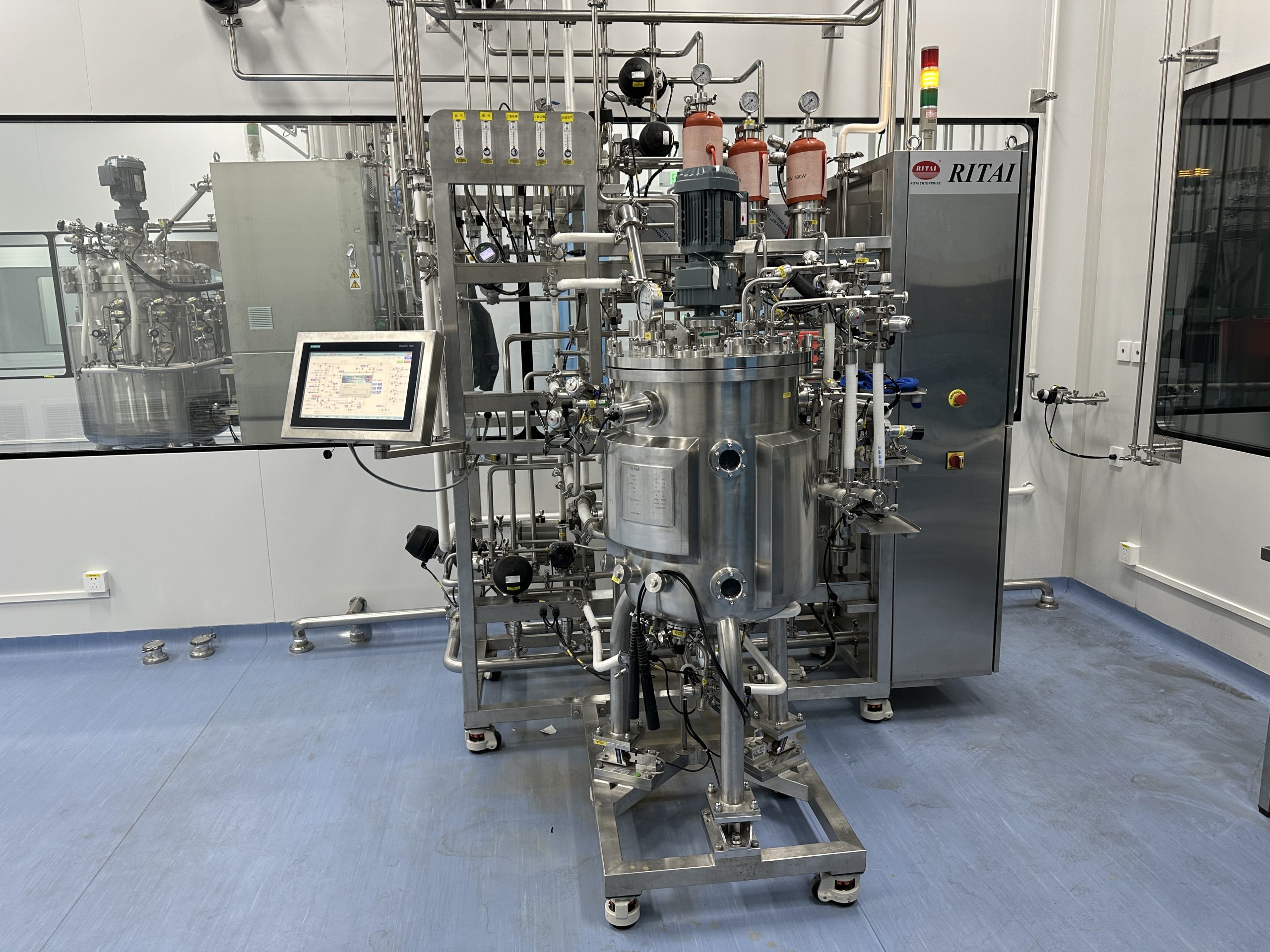
A bioreactor is often pictured as a stainless-steel tank with pipes and a stirrer. What matters is what happens inside: cells need suitable nutrients, oxygen in some processes, controlled temperature and a way to remove heat and waste. As a process grows from a laboratory flask to an industrial vessel, differences in mixing and oxygen transfer become important. The challenge is biological and mechanical at the same time.
A controlled environment
A bioreactor is a vessel or system in which biological processes occur under monitored conditions. Some cultivate bacteria or yeast; others support mammalian cells. Temperature, acidity, oxygen, nutrients and mixing may all affect the outcome.
The role of mixing
Mixing distributes nutrients and gases and can prevent large gradients from forming. But stronger agitation is not always better: shear forces can damage sensitive cells, and vessel geometry influences flow. Engineers balance oxygen delivery, heat removal and mechanical stress.
Growth is only part of the work
Depending on the process, the desired product may be produced during growth or after a change in operating conditions. Researchers measure cell density, metabolite concentrations and product quality, among other variables. Harvesting and purification are distinct stages after cultivation.
A useful companion example of redesigning a biological pathway appears in Building Biology: The Work of Synthetic Biology.
Oxygen transfer is a design problem
Many production organisms require oxygen, but oxygen does not dissolve in water as readily as some other nutrients. A stirred-tank reactor may use an impeller and sparged gas bubbles to improve oxygen transfer. Faster stirring can increase transfer, yet it also changes energy use and mechanical forces on cells. Some mammalian cells are particularly sensitive to damaging shear conditions, while some microbial processes tolerate vigorous mixing. Engineers examine transfer rates, dissolved oxygen measurements and the needs of the culture. Adding more air is not always enough: bubble size, fluid viscosity and reactor geometry also matter. A small experiment can perform well without revealing the oxygen-transfer constraints that emerge during scale-up.
Feeding cells and removing heat
Cells consume nutrients and produce metabolic byproducts. A batch process starts with a defined amount of medium; a fed-batch process adds nutrients over time; and a continuous process exchanges material while the culture runs. Each arrangement changes how growth, product formation and contamination risk must be managed. Metabolism also generates heat. At larger scale, a culture may require active cooling to maintain the intended temperature throughout the vessel. Feed composition influences not only growth but also product quality, particularly for complex biological medicines. Operators follow trends in nutrient concentrations, dissolved gases and byproducts rather than assuming that maximizing cell growth always maximizes useful product.
A sterile process is demanding
Where contamination would spoil a culture or compromise product safety, clean equipment, prepared media and controlled connections are essential. Steam-in-place and clean-in-place systems are common in many industrial contexts, but processes differ according to requirements and materials. Monitoring may include samples that are checked for unwanted organisms or changes in culture performance. A contaminant can outcompete the production strain, consume nutrients or introduce substances that are difficult to remove later. A closed vessel lowers some risks but does not make contamination impossible. Process validation, staff training and careful documentation matter because a bioreactor is part of a production system, not an isolated glass tank with a motor.
What a dissolved-oxygen reading cannot tell you
A dissolved-oxygen probe reports the oxygen level near its sensing tip, not a map of conditions throughout a large vessel. During vigorous growth, oxygen can be consumed more quickly in one region than another. An apparently acceptable reading at one position may conceal areas where cells receive less oxygen, especially when mixing takes longer as the reactor becomes larger.
Engineers therefore compare probe readings with gas-flow measurements, mixing studies and samples taken under defined conditions. They distinguish oxygen concentration from the oxygen transfer rate: one is an amount present at a moment, the other describes how quickly oxygen is replenished. Those are not interchangeable. The distinction matters when a laboratory process is transferred to a much larger vessel, where air distribution, bubble residence time and power input change together.
Measuring what matters
Common instruments track temperature, pH, dissolved oxygen and sometimes carbon dioxide or biomass-related signals. These readings are proxies for aspects of the process, not direct proof of product yield or purity. Samples may be analyzed to quantify the target protein or chemical, evaluate cell viability and measure impurities. Modern systems can integrate sensor data into control loops that adjust gas flow, feeds or agitation. However, a control algorithm is only as reliable as its measurements and the assumptions behind it. If a probe drifts or a sensor becomes fouled, the system may regulate toward the wrong target. Calibration and independent tests therefore remain essential.
Different living systems need different conditions
The word bioreactor also covers more than stirred tanks. Some cultures grow on surfaces, others in suspension, and a few industrial processes use immobilized enzymes rather than reproducing organisms. A vessel used to grow delicate animal cells may be designed around gentle mixing and careful control of dissolved gases. A fermentation system for robust microbes can have quite different mechanical and nutritional requirements. Even when two systems manufacture the same class of molecule, the organisms and process choices may not be interchangeable. Describing the culture type and process mode is therefore indispensable when comparing bioreactor performance.
Oxygen transfer as a worked engineering problem
An aerobic culture consumes dissolved oxygen, but oxygen dissolves only sparingly in water-based media. A stirred-tank bioreactor must replenish it from gas bubbles or the liquid surface. Engineers often use the product kLa, the volumetric mass-transfer coefficient, to describe how effectively oxygen can pass into the broth under particular operating conditions. Increasing agitation can improve transfer but may also increase shear or energy demand. An oxygen reading measured at one point in a small vessel is not proof that an industrial tank is uniformly supplied. Scale-up requires balancing several constraints, not copying the same stirrer speed. [1]
What production numbers conceal
A reported yield might refer to grams of product per gram of substrate, grams per liter of broth, or productivity per liter per hour. Those quantities are not interchangeable. A strain that produces a high final concentration very slowly may be less useful commercially than one with a lower concentration but higher productivity. Downstream purification also matters: a target protein can be present in the reactor and still be expensive to isolate at the required purity. When reading a bioprocess claim, identify the unit, the fermentation conditions and whether the measurement covers the complete production chain.
References
- Bioreactor scale-up and oxygen transfer review
- Miniaturized bioreactor scale-down challenges
- Bioreactor oxygen transfer and scale-up review
Featured image: Habin Zhang, CC BY-SA 4.0. Real bioreactors in operation