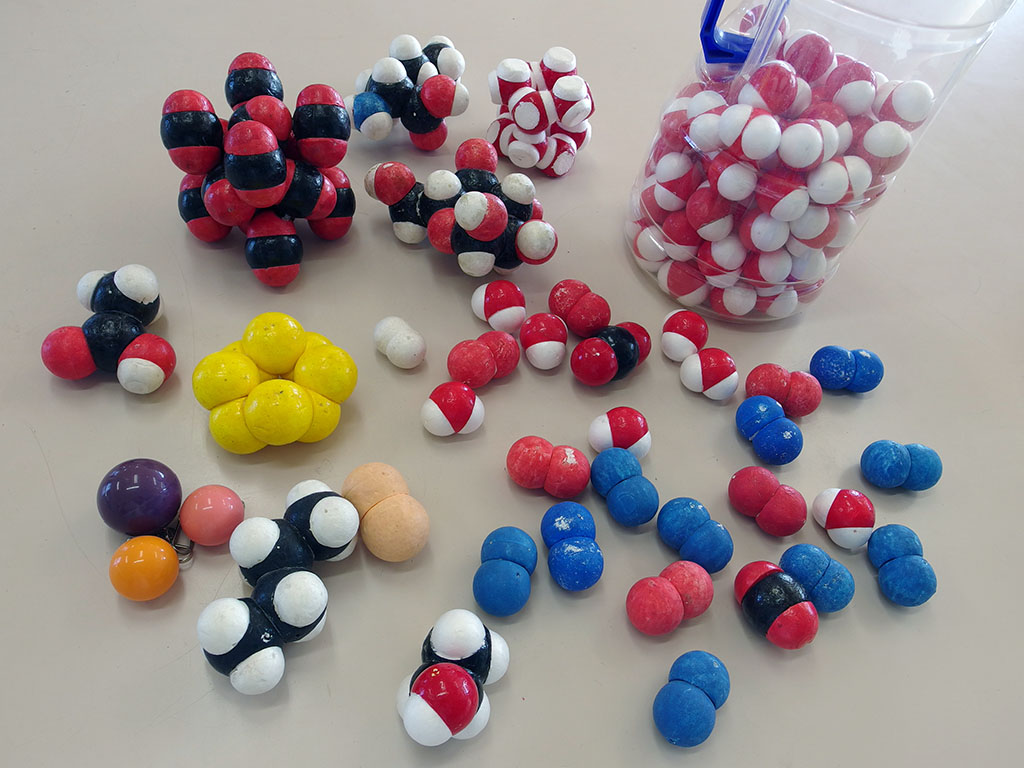
Water, salt, DNA and the gases in air behave differently because their atoms are arranged and connected differently. A chemical bond is one way of describing a stable relationship between atoms: the combined system has a lower energy under certain conditions than the separated arrangement would have.
Electrons and energy
The electrons occupying the outer regions of atoms strongly influence chemical behavior. They are not little planets circling a nucleus on tidy tracks. Quantum mechanics describes their states and the probabilities associated with finding them in particular regions of space.
When atoms approach one another, attractive and repulsive interactions compete. Nuclei attract electrons, while like charges repel. A stable bond can form when the arrangement of nuclei and electrons reaches a favorable balance of these interactions.
Covalent bonds
In a covalent bond, electron density is shared between atoms. The electrons are not always shared equally. Oxygen attracts bonding electrons more strongly than hydrogen does, making the O–H bonds in a water molecule polar.
The consequences for molecular catalysts become clearer in Enzymes: The Chemistry Behind Life’s Reactions.
The shape of the molecule matters as well. Water’s bent geometry means its bond polarities do not cancel, helping explain many of its properties as a solvent. Describing a molecule requires both the kinds of atoms involved and their three-dimensional arrangement.
Ionic interactions
In solid sodium chloride, positively charged sodium ions and negatively charged chloride ions occupy an ordered crystal lattice. It is tempting to imagine each sodium ion joined to one particular chloride ion. The structure is better understood as an extended network of electrostatic interactions.
The formation of ionic solids involves several energy changes, including the energy needed to form the ions and the energy released when a lattice forms. The overall balance determines whether the arrangement is stable.
Metallic bonding
Metals can conduct electricity and often can be shaped without shattering. Their bonding is commonly introduced as positive ion cores held together by delocalized electrons. This model is useful, although the electronic structure of real metals requires more detailed treatment to account for conductivity and other properties.
Why the octet rule is only a guide
Many introductory chemistry problems use the octet rule, the observation that numerous main-group atoms form stable compounds with eight valence electrons around them. It is an effective starting point for drawing Lewis structures, but there are important exceptions. Hydrogen, for example, is stable with only two electrons in its first shell, and some molecules have unusual electron counts or bonding arrangements.
A rule that helps students predict a common pattern is not the same as a universal physical law. Molecular orbital models and more advanced calculations provide a fuller picture.
Bonds in biology
Covalent bonds form the backbones of proteins and nucleic acids. Weaker interactions, including hydrogen bonds and attractions involving charged groups, help determine how these molecules fold and associate with one another. Those weaker interactions are often individually modest but collectively decisive.
Checking a chemical equation with bond energies
A useful estimate of reaction enthalpy can be made by adding the energies needed to break reactant bonds and subtracting the energy released when product bonds form. The sign matters. Breaking stable chemical bonds requires energy; the overall reaction releases energy only when forming the products returns even more. This method uses average bond dissociation energies, so it gives an estimate rather than an exact prediction for every molecule and physical state. Enthalpy also does not tell us how quickly a reaction proceeds; that depends on the pathway and activation-energy barrier. For a measured example, OpenStax lists a hydrogen–hydrogen bond energy of about 436 kilojoules per mole for gaseous H₂. That number describes the cost of separating the pair, not an energy windfall from the bond being broken. See the bond-strength and reaction-energy discussion for the distinction.
DNA base pairing is a familiar example. Hydrogen bonding contributes to specificity, while base stacking and the surrounding solution also affect double-helix stability. The behavior cannot be reduced to a single type of bond.
Bond length and bond strength
A bond is associated with a characteristic range of distances between atoms, rather than a perfectly rigid connection. The atoms vibrate, and the preferred distance depends on their electronic structure and surroundings. In many simple cases, shorter bonds are stronger, but comparisons across different molecules require care.
A carbon–carbon single bond, for example, is generally longer than a carbon–carbon double bond. The distinction reflects differences in electron distribution and bonding, but actual lengths can shift depending on the rest of the molecule. Measurements from spectroscopy and diffraction give chemists evidence about these structures.
Why molecules have shapes
Introductory models often predict molecular geometry by considering how electron groups around a central atom repel one another. This approach helps explain why methane is approximately tetrahedral and water is bent. It is useful because shape affects physical properties and chemical reactions.
More detailed models represent electrons through molecular orbitals extending across multiple atoms. Those models can explain features that simple sketches cannot, including some aspects of delocalization and magnetism. Chemists choose a model based on the question they need to answer, not because one drawing is a complete picture of reality.
Bond energy is not reaction speed
The energy difference between reactants and products does not tell us how quickly they will react. A reaction may release energy overall yet proceed slowly because molecules must first pass through a high-energy arrangement called a transition state. A spark can initiate combustion, for example, even though the overall chemical change is energy-releasing. The activation barrier and the overall energy change answer different questions.
Catalysts offer a different reaction pathway with a lower activation barrier; they do not change the energy difference between the same starting and ending states. This distinction becomes especially important in biological chemistry, where enzymes can accelerate reactions that would otherwise proceed too slowly under mild conditions. Bond dissociation energies can help estimate enthalpy changes, but they do not by themselves predict a reaction rate.
A hydrogen molecule and the energy curve
Two isolated hydrogen atoms attract one another as they approach because each electron can be attracted to both nuclei. At very short separations, repulsive interactions rise sharply. Between those extremes lies a lower-energy arrangement: the bonded hydrogen molecule. This is why a bond has a characteristic length and why separating the atoms requires an input of energy. The common phrase “atoms bond to fill their shells” can be useful for certain main-group patterns, but it hides the underlying balance of attractions, repulsions and quantum-mechanical electron behavior. [1]
Water and carbon dioxide show why molecular geometry matters
Both a water molecule and a carbon-dioxide molecule contain polar bonds, but their overall charge distributions are different. Carbon dioxide is linear in its common ground-state geometry, so the two equal carbon–oxygen bond dipoles point in opposite directions and cancel. Water is bent; its oxygen–hydrogen bond dipoles do not cancel, and the molecule is polar. The comparison explains why knowing only which atoms are connected is not sufficient to predict physical behavior. Molecular shape and the distribution of electron density matter together. The same principle helps interpret why some molecules interact strongly with water while others do not, though size, temperature and other forces also affect solubility. Students sometimes draw a correct chemical formula and assume it already gives the structure. It does not. A Lewis structure is a starting model, and geometry must be considered separately. See the OpenStax explanation of polarity and shape for a worked comparison.
References
- Chemical bond strengths and energies
- Molecular structure and polarity
- OpenStax Chemistry 2e: Covalent bonding
Featured image: Miyuki Yamamoto, CC BY-SA 4.0. Models represent bonding; atoms are not directly photographed