A yeast cell can be redesigned to produce a chemical that normally belongs to a plant pathway. That idea sounds straightforward until researchers try to balance several enzymes, limit toxic intermediates and keep the cells growing. Synthetic biology uses engineering methods to investigate such problems, but living systems do not behave like interchangeable electronic components. Success depends on experiments, measurements and revision.
An engineering approach
Synthetic biology brings tools from genetics, biochemistry, computation and engineering into the same workflow. Researchers may redesign a regulatory sequence, assemble a biochemical pathway or alter how a microorganism responds to a signal. The phrase covers a wide range of methods rather than one technology.
Biological parts are context-dependent
Engineers may assemble promoters, regulatory proteins, coding sequences and other DNA elements into genetic circuits. A promoter influences how much RNA is made, while other elements can determine when and where that happens. The phrase “biological part” suggests standardized interchangeable components, but their behavior can change dramatically with host organism, growth conditions and placement in the genome. Proteins compete for cellular resources, and regulatory signals may interfere with one another. Even a well-characterized component can behave differently after it is combined with others. This is a central practical challenge: living systems evolve, adapt and contain many interacting processes that cannot be ignored. Standardization helps comparison, but it never abolishes biological context.
Circuits that sense and respond
One common design is a circuit that turns on a measurable output when a particular signal is present. A biosensor may detect a chemical cue through a regulatory protein and then express a fluorescent marker or generate a different measurable response. Researchers must establish sensitivity, specificity, response time and performance in realistic samples. A sensor that detects a substance in carefully prepared laboratory water may struggle in soil or blood, where interfering chemicals and biological material are abundant. Likewise, a regulatory circuit designed to hold a protein concentration steady may generate noise or oscillations rather than perfect control. Modeling can predict some behavior, but actual measurement remains indispensable.
Making useful molecules
Engineered microbes are used or studied for producing enzymes, medicines, chemicals and research reagents. In metabolic engineering, researchers may introduce new enzyme steps or alter the flow of existing pathways so that more starting material reaches a desired product. Cells need energy, building blocks and a balanced internal environment; diverting too many resources toward one product may slow growth or reduce production stability. A process that produces a promising amount in a small flask may perform differently in a larger controlled vessel. Production also requires downstream purification and quality checks. The final value of a biological design depends not only on genetic ingenuity but also on safety, reliability, economics and the requirements of the intended application.
Safety and containment
Modifying organisms creates questions about unintended behavior, exposure and how material is controlled outside the laboratory. Researchers evaluate these concerns according to the organism, introduced sequences, products and intended use. Institutional biosafety procedures, containment practices and relevant regulations guide work; they cannot be replaced by a generic promise that engineered biology is harmless. Some teams design genetic safeguards that limit survival under specified conditions, but no safeguard should be described as infallible. Public discussion also includes who receives the benefits of a technology and who bears its risks. An article can describe these issues without implying that every synthetic biology project is either a breakthrough or a threat.
The limits of the engineering metaphor
What yeast-made artemisinin precursors demonstrate
One well-known synthetic-biology project engineered microbes to make molecules used in the production of artemisinin-derived antimalarial medicines. The project was not simply a matter of inserting one gene and receiving a finished drug. Researchers had to organize enzymes into a working metabolic pathway, supply the appropriate precursors, adjust cellular processes and improve production under fermentation conditions. The output of a strain in a flask did not automatically establish a practical manufacturing process. Work with engineered yeast produced the precursor artemisinic acid, which could then undergo chemical conversion as part of the manufacturing route. The case illustrates the difference between demonstrating a biological function and delivering a reliable product at useful scale. A review of the semi-synthetic artemisinin project describes the engineering and production issues that made the example important.
Cells are not passive circuit boards. They mutate, compete, regulate their own metabolism and interact with changing environments. A design can lose performance over many generations because mutations that reduce its burden on a cell may spread. Researchers test genetic stability, measure production across growth conditions and refine models based on results. The field has advanced because it combines engineering discipline with biological humility. A successful build is one that performs a defined task reproducibly under stated conditions, not one that merely looks elegant in a diagram. For readers, the important question is what was designed, how it was tested and what evidence demonstrates that it works.
What counts as success
A fluorescent signal or a measurable chemical product can prove that a design did something, but not necessarily that it did the intended job well enough for practical use. A robust synthetic biology result specifies the starting conditions, compares engineered and control cells, reports repeatability and measures unintended effects where feasible. Researchers may need to show that a design continues working across many generations or variable environmental conditions. Reporting failure is also valuable because it reveals biological constraints the original design missed. A field that borrows engineering language needs engineering-style performance evidence, not just clever diagrams of genetic parts.
When a genetic design is unstable
A useful genetic circuit has to work for more than a single measurement. If making the intended product takes resources away from growth, cells with mutations that reduce production may have a competitive advantage during repeated cultivation. Over many generations, a culture can become less productive even if the original design performed well in its first tests.
Researchers investigate stability by sampling cultures over time, measuring both the desired output and the proportion of cells that retain the engineered sequences. They may reduce the metabolic burden, balance pathway expression or integrate a design into the chromosome rather than rely on an unstable plasmid. Even then, results depend on the host organism and process conditions. Long-term stability is therefore a separate experimental result, not something guaranteed by an impressive first-day yield.
A design-build-test cycle has to measure something
A gene circuit may work in a computer model yet behave differently once placed inside a cell. Promoters can be influenced by growth state, proteins compete for resources, and mutations can change performance over time. A good iteration defines a quantitative outcome—perhaps the amount of product per unit culture volume, sensor response time, or stability across generations—and compares it with a baseline. Failed designs are informative when experiments identify which assumption broke down. The engineering vocabulary becomes useful only when coupled with reproducible measurements and honest reporting of uncertainty.
Moving an engineered strain from an experiment to production introduces a different set of constraints, including mixing and oxygen supply, explored in What Happens Inside a Bioreactor?.
References
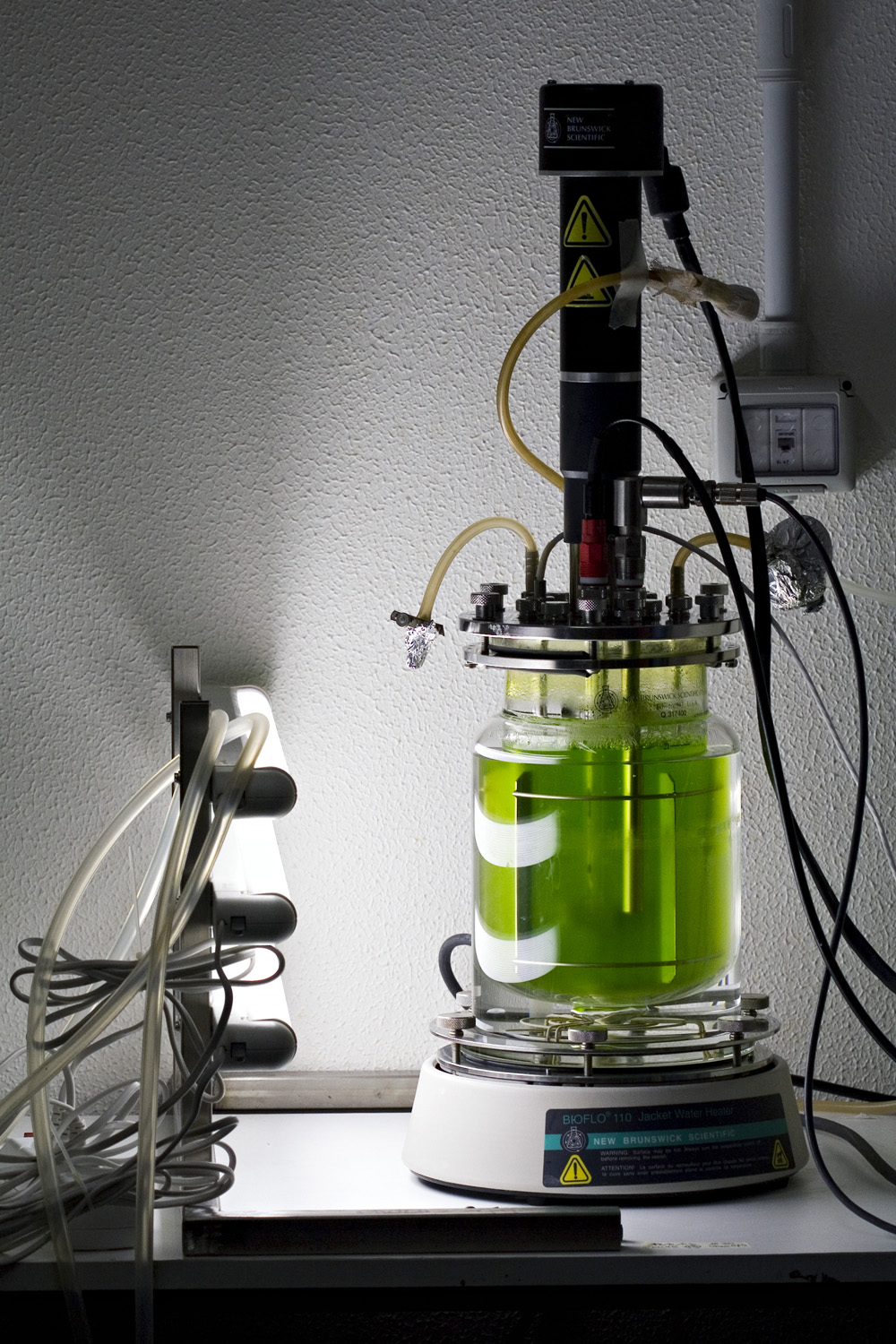
Featured image: Umberto Salvagnin, CC BY 2.0. Shows algal cultivation, not proof of genetic engineering