Two siblings can inherit DNA from the same parents and still receive markedly different combinations of variants. Independent assortment of chromosomes explains part of that difference. Another source lies in an exchange that takes place while eggs and sperm are developing: crossing over. During meiosis, paired chromosomes can swap corresponding stretches of DNA. This rearranges existing variants into combinations that were not present together on either parental chromosome, and it also helps chromosomes separate accurately.
Two versions of each chromosome meet
Most human body cells contain two sets of chromosomes, one inherited from each parent. Before a cell begins meiosis, it replicates its DNA, so each chromosome consists of two sister chromatids. During the early stages of meiosis I, homologous chromosomes find and pair with each other. A homologous pair carries broadly corresponding genes at the same positions, although the two chromosomes can carry different variants of those genes. These homologs are not the same as sister chromatids, which are produced by replication of one chromosome.
The pairing is unusually precise. Protein structures help hold the homologous chromosomes close while their DNA is compared and repaired. One of these structures is the synaptonemal complex. In illustrations, chromosomes often look like two neat X shapes placed together. In a real meiotic nucleus, the arrangement is dynamic and unfolds along extended chromatids that are far less tidy than textbook cartoons imply. The physical alignment creates the opportunity for recombination between non-sister chromatids.
Crossing over begins with a break
A crossover usually begins when an enzyme-driven process creates a double-strand break in DNA. In many organisms, including humans, the protein SPO11 has a central role in initiating these breaks. That might sound alarming, since double-strand breaks are potentially dangerous in most cellular settings. During meiosis, however, controlled breaks provide the entry point for a carefully regulated recombination process. Broken DNA ends are processed, and one strand searches for a corresponding sequence on a homologous chromosome.
Once a matching sequence is found, a DNA strand can invade the homologous double helix and use it as a template. The resulting intermediate may be resolved in ways that produce either a crossover, with an exchange of chromosome arms, or a noncrossover repair event. Not every programmed break becomes a crossover. Cells make more breaks than the minimum number of exchanges needed, then regulate how they are repaired. Treating every break as a completed swap would misrepresent the mechanism and the evidence observed by geneticists.
A concrete inheritance example
Imagine two nearby gene positions, A and B. One chromosome carries variants A1 and B1, while its homolog carries A2 and B2. Without crossing over between these positions, the chromosome combinations passed along at that region would tend to remain A1–B1 or A2–B2. A crossover between the positions can generate A1–B2 and A2–B1 combinations. The variants have not been invented by the process. Their relative arrangement on a chromosome has changed.
This is why the distance between genes matters in classical genetic mapping. Genes close together are less likely to be separated by a crossover in any single meiosis than genes farther apart. Recombination frequency therefore provides an imperfect but useful measure of genetic distance. It is imperfect because crossover rates vary along chromosomes, interference affects the spacing of exchanges, and multiple crossovers can obscure what happened when only the final inheritance pattern is observed.
| Event | What changes? | What does not follow automatically? |
|---|---|---|
| Independent assortment | Different chromosome pairs are distributed into gametes | It does not necessarily break up genes on the same chromosome |
| Crossing over | Homologous chromosomes exchange corresponding DNA segments | Not every crossover changes a measured trait |
| Fertilization | Two gametes combine their genomes | It does not guarantee a particular trait appears |
Crossing over is not spread evenly
Different sections of the genome recombine at different rates. Many human crossover events occur in regions called recombination hotspots, whose locations are influenced by proteins and chromosome context. At the same time, a crossover in one location often reduces the likelihood of another nearby. This phenomenon, known as crossover interference, helps distribute exchanges instead of allowing them to cluster randomly. It is part of the reason that genetic distance is not simply physical distance measured in DNA letters.
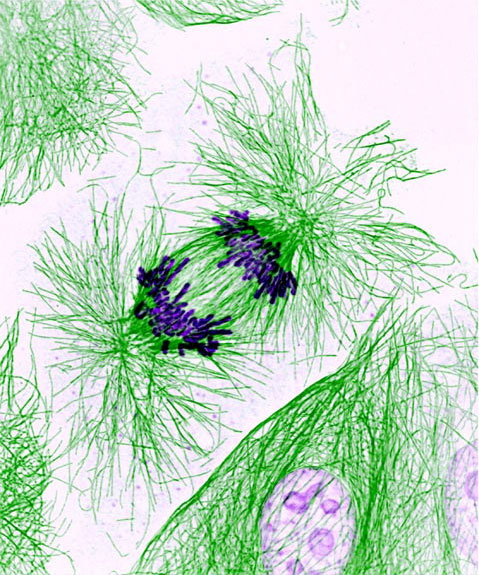
A microscope can sometimes reveal the physical consequence of crossing over as a chiasma, the connection between homologs after they have begun to separate. Chiasmata, together with cohesion between sister chromatids, help homologous chromosomes stay properly connected until they segregate in the first meiotic division. This gives crossing over a mechanical role as well as a genetic one. Recombination increases the variety of gametes, but the connection it creates also supports orderly division.
What goes wrong when chromosomes fail to separate?
During meiosis I, the cell must send one homolog from each pair toward each daughter cell. A failure of separation, called nondisjunction, can produce gametes with abnormal chromosome numbers. In humans, such events contribute to certain aneuploidies. Recombination patterns are among several factors associated with accurate separation; the relationship is complex, and no single crossover count predicts the outcome of an individual pregnancy. Age-related changes and other aspects of chromosome cohesion also matter.
It is important to distinguish a copying error from an exchange error. DNA replication errors can introduce new sequence variants. Crossing over generally rearranges existing variants between homologs. A chromosome-number change results from segregation problems. Although these processes can interact, they are not synonyms. For an explanation of how the DNA was copied before meiosis begins, see What Happens When DNA Is Copied?. For changes in chromosome structure and number, see When Chromosomes Change.
How scientists detect recombination
Early geneticists inferred crossing over by following inherited traits through offspring. Today, sequencing and dense maps of genetic markers can identify recombination events with much greater precision. A geneticist might compare parental and offspring DNA to locate where a child’s inherited chromosome switches from one grandparental haplotype to another. The result is a map of ancestry along the chromosome, not a direct movie of the meiosis that produced it.
Experimental organisms allow more direct work. Researchers can manipulate proteins involved in pairing and repair, image meiotic chromosomes, and count recombination-associated structures. A decrease in successful gametes after a gene is disrupted can be informative, but it does not automatically demonstrate the precise step that failed. Pairing, break formation, repair, and segregation must be tested separately. Good meiosis research takes that sequence of possibilities seriously.
Why the exchange matters
Crossing over is often introduced as a way to create diversity, and that is true. But it is also a solution to a practical problem: homologous chromosomes need reliable physical connections while a cell reduces its chromosome number. Meiosis turns replicated DNA into genetically varied haploid cells through coordinated pairing, recombination, and two rounds of division. This is the molecular basis for inheritance patterns that cannot be predicted from a simple single-gene Punnett square. Readers interested in those patterns can continue with Why Some Traits Run in Families.
References and further reading
Featured image: Yana Balakhonova · CC BY-SA 4.0.